The Meng 1/35 Merkava MK3D early ,

I will try to build this tank (will be my first 'modern' AFV ) also will try to create a diorama with it and try to get some IDF tankers figures to place on it . With Three expected builds in Rising Sun GB , I do not know how I will have the time to do on this , but also seems that the Japanese builds could be quick , so , I will try to do this as the Merkava is one of my favourite modern AFV's .
Some information on the Merkava from Wiki...
Type Main battle tank
Place of origin Israel
Service history
In service 1979–present
Used by Israel Defense Forces
Wars 1982 Lebanon War, South Lebanon conflict, 2006 Lebanon War, First Intifada, Second Intifada, Gaza War, Operation Pillar of Defense, Operation Protective Edge
Production history
Designer MANTAK
Manufacturer MANTAK/IDF Ordnance Corps (assembly)
Unit cost Est. $6 million
Produced Since 1974
Number built (As of March 2012)
Mark I: 250
Mark II: 580
Mark III: 780
Mark IV: 360 (another ~300 on order)
Specifications
Weight 65 tonnes (143,000 pounds)
Length 9.04 m or 29.7 ft (incl. gun barrel)
7.60 m or 24.9 ft (excl. gun barrel)
Width 3.72 m or 12.2 ft (excl. skirts)
Height 2.66 m or 8.7 ft (to turret roof)
Crew 4 (commander, driver, gunner, and loader)
Passengers Maximum 6 passengers
Armor Classified composite/sloped armour modular design.
Main armament:
120 mm (4.7 in) MG253 smoothbore gun, capable of firing LAHAT ATGM
Secondary armament
1 × 12.7 mm (0.50 in) MG
2 × 7.62 mm (0.300 in) MG
1 × 60 mm (2.4 in) internal mortar
12 smoke grenades
Engine 1,500 hp (1,119 kW) turbocharged diesel engine
Power/weight 23 hp/tonne
Payload capacity 48 rounds
Transmission Renk RK 325
Suspension Helical spring
Ground clearance 0.45 m (1.5 ft)
Fuel capacity 1,400 litres
Operational range 500 km (310 mi)
Speed 64 km/h (40 mph) on road
55 km/h (34 mph) off road
The Merkava (Hebrew: "chariot") is a main battle tank used by the Israel Defense Forces. The tank began development in 1973 and entered official service in 1979. Four main versions of the tank have been deployed. It was first used extensively in the 1982 Lebanon War. The name "Merkava" was derived from the IDF's initial development program name.
It is designed for rapid repair of battle damage, survivability, cost-effectiveness and off-road performance. Following the model of contemporary self-propelled howitzers, the turret assembly is located closer to the rear than in most main battle tanks. With the engine in front, this layout is intended to grant additional protection against a frontal attack, especially for the personnel in the main hull, like the driver. It also creates more space in the rear of the tank that allows increased storage capacity, as well as a rear entrance to the main crew compartment allowing easy access under enemy fire. This allows the tank to be used as a platform for medical disembarkation, a forward command and control station, and an Infantry fighting vehicle. The rear entrance's clamshell-style doors provide overhead protection when off- and on-loading cargo and personnel.
It was reportedly decided shortly before the beginning of the 2006 Lebanon War that the Merkava line would be discontinued within four years. However, on November 7, 2006, Haaretz reported that an Israeli General staff assessment had ruled of the Merkava Mark IV that "if properly deployed, the tank can provide its crew with better protection than in the past," and deferred the decision on discontinuing the line. On August 16, 2013, Israeli Defense Minister Moshe Ya'alon announced the decision to resume production of the Merkava main battle tank for the IDF Armored Corps.
Development[edit]
In 1965, Israel's military establishment began research and development on a domestically produced tank, the "Sabra" (not to be confused with the later model of the same name now in service). Initially, Britain and Israel collaborated to adapt the United Kingdom's Chieftain tank that had entered British Army service in 1966. However, in 1969, Britain decided not to sell the tank to Israel for political reasons.
Israel Tal, who was serving as a brigade commander after the Suez Crisis, restarted plans to produce an Israeli-made tank, drawing on lessons from the 1973 Yom Kippur War, in which Israeli forces were outnumbered by those of the Middle East's Arab nations.
By 1974, initial designs were completed and prototypes were built. After a brief set of trials, work began to retool the Tel HaShomer ordnance depot for full-time development and construction. After the new facilities were completed, the Merkava was announced to the public in the International Defense Review periodical. The first official images of the tank were then released to the American periodical Armed Forces Journal on May 4, 1977. The IDF officially adopted the tank in December 1978. The first Merkava Mk. 1 tanks were supplied to the IDF in April 1979, nearly nine years after the decision to produce the Merkava Mk. 1 tank was taken.
Primary contractors:
The lead organization for system integration of the Merkava's main components is Israel Military Industries (IMI). The Israeli Ordnance Corps are responsible for final Merkava assembly. Contributors to the vehicle include:
IMI manufactures the 105 mm and 120 mm main guns and their ammunition;
Urdan Industries assembles and constructs the hull, drive- and powertrains, and turret assemblies;
Soltam manufactures the 60 mm internal mortar;
Elta designs and manufactures the electronic sensors and infrared optics;
Elbit delivers the ballistics computer and digital fire-control system (FCS);
Tadiran provides cabin air conditioning, crew cabin intercom and radio equipment;
El-Op, Elisra and Astronautics implement the optics and laser warning systems;
Rafael Advanced Defense Systems builds and installs the Rafael Overhead Weapon Station and Trophy active protection system;
L-3 Communication Combat Propulsion Systems produces licensed copies of Germany's MTU MT883 1500 hp diesel engine powerplant and RENK RK325 transmissions;
Motorola supplies Tadiran communication encryption systems;
DuPont supplies the Nomex, ballistic, and fire-retardant materials used by Hagor;
Russia Military Industries helped to design the KMT-4 & -5 anti-mine rollers and the ABK-3 dozer blade, now built by Urdan;
FN Herstal supplies 7.62 mm (MAG 58) and 12.7 mm (M2) coaxial and pintle-mounted machine guns;
Caterpillar assisted with an Israeli-designed track system.
Bental Industries, a TAT Technologies subsidiary, produced the brushless motors used in the Mark IV's turret and gun control system.
General characteristics
Firepower
The Merkava Mark I and II were armed with a 105 mm M68 gun. The Mark III, Mark III Dor Dalet BAZ kassag, and the Mark IV are armed with an IMI 120 mm smoothbore gun.
Each model of the Merkava has two 7.62 machine guns for anti-infantry defense and a 60 mm mortar.
Mobility
The tank's 1,500 horsepower turbocharged diesel engine was designed by MTU and is manufactured under license by L-3 Communication Combat Propulsion Systems (formerly General Dynamics). The Mark IV's top road speed is 64 km/h.
Merkava Mark III
Variants of the Merkava Mark III
The Merkava Mark III was introduced in December 1989, and had upgrades to the drivetrain, powertrain, armament, and electronic systems. The most prominent addition was the incorporation of the locally developed IMI 120 mm gun.[16] This gun and a larger 1,200 horsepower (890 kW) diesel engine increased the total weight of the tank to 65 tonnes (143,000 lb), but the larger engine increased the maximum cruising speed to 60 km/h (37 mph).[17]
The turret was re-engineered for movement independent of the tank chassis, allowing it to track a target regardless of the tank's movement. Many other improvements were made, including:
External two-way telephone for secure communications between the tank crew and dismounted infantry,
Upgraded ammunition storage containers to minimize ammunition cook-off,
Addition of laser designators,
Incorporation of the Kasag modular armor system, designed for rapid replacement and repair in the battlefield and for quick upgrading as new designs and sophisticated materials become available,
Creation of the Mark IIIB, with unspecified armor upgrades.
BAZ System
The 1995 Mark III BAZ (Hebrew acronym for ברק זוהר, Barak Zoher, signifying Shining Lightning[18]) had many improved and additional systems including:
Upgraded fire-control system components, from Electro Optics Industries (EL-OP) and Elbit, provides the tank with the ability to engage moving targets while on the move (an automatic target tracker),
NBC protection systems,
Locally developed central air-conditioning system,
Added improvements in ballistic protection,
The Mark IIID has removable modular composite armor on the chassis and turret.
Dor-Dalet
The last generation of the Mark III class was the Mark IIID Dor-Dalet (Hebrew: Fourth Generation), which included several components as prototypes to be introduced in the Mark IV.
Upgraded and strengthened tracks (built by Caterpillar, designed in Israel),
Installation of the R-OWS (Rafael Overhead Weapon Station is a remote weapon station)
Mark 3:
In active service since :1990
Wars :
South Lebanon conflict, Second Intifada, 2006 Lebanon War, Gaza War, 2014 Israel–Gaza conflict
Combat history:
The Merkava was used widely during the 1982 Lebanon War. The tank outperformed contemporary Syrian tanks (mostly T-62s) and proved largely immune to the anti-tank weapons of the time (the AT-3 Sagger and RPG-7) that were used against it. It was judged to be a significant improvement over Israel's previously most effective main battle tank, the Centurion.34 Merkava tanks were lost during war
In February 2002, a Merkava III was destroyed by a roadside bomb near Netzarim in the Gaza Strip. The tank was lured into intervening in an attack on a settler convoy. The tank went over a heavy mine, which detonated and totally destroyed the tank. Four soldiers were killed in the blast. This was the first heavy tank to be destroyed during the Second Intifada. A second Israeli tank, a Merkava II or Merkava III, was destroyed a month later in the same area and a further three soldiers were killed. A third Merkava II or III tank was destroyed near the Kissufim Crossing, when one soldier was killed and two wounded.
During the 2006 Lebanon War, five Merkava tanks were destroyed. Only the minority of the tanks used during the war were Merkava Mark IVs, as by 2006 they had still only entered service in limited numbers. Hezbollah fired over 1,000 anti-tank missiles during the conflict against both tanks and dismounted infantry. Some 45 percent of all tanks and armoured vehicles hit with antitank missiles during the conflict suffered some form of armour penetration. In total, 15 tank crewmen were killed by these ATGM penetrations.The penetrations were caused by tandem warhead missiles. Hezbollah weaponry was believed to include advanced Russian RPG-29 'Vampir', AT-5 'Konkurs', AT-13 'Metis-M', and laser-guided AT-14 'Kornet'[28] HEAT missiles. The IDF reported finding the state-of-the-art Kornet ATGMs on Hezbollah positions in the village of Ghandouriyeh. Several months after the cease-fire, reports have provided detailed photographic evidence that Kornet ATGMs were indeed both in possession of, and used by, Hezbollah in this area. Another Merkava IV tank crewman was killed when a tank ran over an improvised explosive device (IED). This tank had additional V-shaped underside armor, limiting casualties to just one of the seven personnel (four crewmen and three infantrymen) on board. In total, five Merkava tanks (two Merkava IIs, one Merkava III, and two Merkava IVs) were destroyed.Of these two Merkava Mark IVs, one was by powerful IEDs, and the other by Russian AT-14 'Kornet' missiles. The Israeli military said that it was satisfied with the Merkava Mark IV's performance, and attributed problems to insufficient training before the war.In total, 50 Merkava tanks (predominantly Merkava IIs and IIIs) were damaged, eight of which remained serviceable on the battlefield. 21 tanks suffered armour penetrations (15 from missiles, and 6 from IEDs and anti-tank mines).
After the 2006 war, and as the IDF becomes increasingly involved in unconventional and guerrilla warfare, some analysts say the Merkava is too vulnerable to advanced anti-tank missiles, that in their man-portable types can be fielded by guerrilla warfare opponents.Other post-war analysts, including David Eshel, disagree, arguing that reports of losses to Merkavas were overstated and that "summing up the performance of Merkava tanks, especially the latest version Merkava Mark IV, most tank crews agree that, in spite of the losses sustained and some major flaws in tactical conduct, the tank proved its mettle in its first high-saturation combat."[36] On a comparison done by the armor corps newsletter, it was shown that the average number of crewmen killed per tank penetrated was reduced from 2 during the Yom Kippur War to 1.5 during the 1982 Lebanon War to 1 during the 2006 Lebanon War proving how, even in the face of the improvement in anti-tank weaponry, the Merkava Mark IV provides better protection to its crew (although only a limited number of the Israeli tanks used in 2006 were Merkava Mark IVs). The IDF wanted to increase orders of new Merkava Mark IV tanks, and planned to add the Trophy active protection system to Merkava Mark IV tanks, and to increase joint training between crews and Israeli antitank soldiers.
The Merkava IV was used more extensively during the Gaza War, as it had been received by the IDF in increasing numbers since 2006, replacing more of the Merkava II and III versions of the tank that were in service. One brigade of Merkava IVs managed to bisect the Gaza strip in five hours without casualties. The commander of the brigade stated that battlefield tactics had been greatly revised since 2006. Tactics had also been modified to focus on asymmetric or guerilla war threats, in addition to the conventional war scenarios that the Merkava had primarily been designed to combat. By October 2010, the IDF had begun to equip the first Merkava IVs with the Trophy active protection system, to improve the tanks' protection against advanced anti-tank missiles which use tandem-charge HEAT warheads.Added protection systems included an Elbit laser-warning system and IMI in-built smoke-screen grenades.
In December 2010, Hamas fired an AT-14 Kornet anti-tank missile at a Merkava Mark III tank stationed on the Israel-Gaza border near Al-Bureij. It had hitherto not been suspected that Hamas possessed such an advanced missile. The missile penetrated the tank's armour, but caused no injuries among its crew. As a result of the attack, Israel decided to deploy its first Merkava Mark IV battalion equipped with the Trophy active protection system along the Gaza border.
On March 1, 2011, a Merkava MK IV stationed near the Gaza border, equipped with the Trophy active protection system, successfully foiled a missile attack against it, marking the system's first operational success.
Some photos of it :


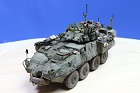


 , must check the instructions carefully !


 ) to decide the color , do not know if use Sand grey or the Sinai Grey modern , maybe this one as I like the look of this color !


 some grease on them ...MEng Models , at least I built two already have some mold grease i some parts ...





 , then discover that the lost piece jump from my tweezer to 'land' in a diorama that is in a shelf besides me ...


 The dio is really nice, and the tank looks incredible! Good luck on the figs